If a Baby Is Making Speech-like, but Meaningless, Sounds, This Is a Universal Phenomenon Called
Introduction
Introspective linguistic judgments about the well-formedness of linguistic stimuli have long been regarded as ane of the near important sources of show in linguistics, essentially forming its empirical base (Wexler et al., 1975; Carr, 1990; Schütze, 1996/2016; Baggio et al., 2012). Both the techniques used to elicit such judgments (due east.m., controlled experiments, self-introspection, or targeted questioning about whether a specific sentence sounds fine in a specific linguistic communication) as well as the type of sample that is necessary for the results to accept ecological validity (eastward.g., a pool of participants that is randomly selected from the targeted linguistic community, a non-random sample, or cocky-introspection) are a affair of argue (meet Phillips, 2009; Gibson and Fedorenko, 2010; Sprouse and Almeida, 2013; Branigan and Pickering, 2016). On the other paw, no controversy exists over the fact that judgments near what forms part of a person'southward linguistic repertoire constitute a rich source of data in theoretical and experimental linguistics.
Since these judgments have such a cardinal role in the report of language, ane would expect that the question of what they tap into would be one of the start questions in linguistics to provide an indisputable answer to. Merely that does not seem to be the case. If 1 searches PubMed or any other database for the terms "acceptability judgment tasks" and "linguistic communication" on the one hand, and "grammaticality judgment tasks" and "language" on the other, one volition quickly detect that the relevant experiments that will bear witness up are the same. They all written report findings that are based on the exact same elicitation technique. Mayhap the greatest illustration of how the terms "acceptability" and "grammaticality" are used, ofttimes without a clear stardom in place, comes from Schütze'south (1996/2016) seminal book on linguistic judgments. While the title of the volume talks nigh "grammaticality judgments and linguistic methodology," the very first quote given in the 2016 edition of the book is by Bever (1970), who claims that information technology is simultaneously the greatest virtue and failing of linguistic theory that acceptability judgments are used as the basic data (Schütze, 1996/2016: v). In the preface of the beginning edition, information technology is argued that "[t]hroughout much of the history of linguistics, judgments of the grammaticality/acceptability of sentences (and other linguistic intuitions) accept been the major source of evidence in amalgam grammars" (p. xi, accent added).
Just as linguists and other cognitive scientists have at times used the terms "ungrammatical" and "unacceptable" roughly synonymously, plurality and overlapping may characterize the use of symbols like ?, *, or ??, that are employed to indicate some deviant holding of the linguistic stimulus (Bard et al., 1996). To ascertain the relevant terms, the grammaticality of a judgement refers to whether the sentence conforms to the syntactic rules of a given language (Fromkin and Rodman, 1998: 106), or put another fashion, "it is a characteristic of the stimulus itself" (Bard et al., 1996: 33). With respect to acceptability, the focus moves from the stimulus to a speaker's perception; in Bard et al.'southward (1996) words, it "is a feature of the stimulus equally perceived past a speaker" (p. 33). Linguistics, even so, is non a science that works exclusively with visible primitives; we cannot zoom in on a linguistic stimulus until we notice and tease autonomously an independent, self-contained grammatical core. This means that grammaticality, as one of the possible elements that make up one's mind acceptability, "is non straight accessible to observation or measurement" (Lau et al., 2016: 3). The question thus becomes: How do nosotros know anything about grammaticality aside of the data provided by acceptability? Put differently, if grammaticality is defined as "befitting to the rules of the grammar of linguistic communication 10" and if the grammar of linguistic communication X has the shape that its speakers' judgments and actual functioning give it, what fashion do nosotros accept to capture grammaticality other than the one that goes through speakers' perception of well-formedness (i.e., acceptability)?1
Answering this question is the primary goal of the present work. The starting point of the discussion is Chomsky's (1965) distinction between the terms "acceptability" and "grammaticalness," according to which these ii notions and their scales might not coincide, hence his reference to "unacceptable grammatical sentences": sentences that do not course function of grammar for reasons that have naught to do with grammar. The 2nd aim of the present work is to chart the variation space that is created when ane disentangles the two notions: unacceptable grammatical sentences, acceptable ungrammatical sentences, their respective parsability, and the process of assigning them meaning. Last, the scales of grammaticality and acceptability volition be discussed and it will be shown that they do not coincide: there are n ways of unacceptability, but only 2 ways of ungrammaticality, in the absolute and the relative sense.
Acceptable Ungrammatical Sentences and Unacceptable Grammatical Sentences
Humans are surprisingly skilful at providing accurate and consistent judgments about what forms part of their linguistic repertoire.2 Although informants' opinions about their linguistic behavior are not ever concordant with the mode they actually speak (Labov, 1996; Cornips and Poletto, 2005), acceptability judgment tasks are reliable equally a tool, and the majority of linguistic stimuli can receive unambiguous, consistent judgments. For example, piddling argue would occur amongst native speakers of English nearly the acceptability of (1) or the unacceptability of (2). The former is a grammatically well-formed sentence of English, while the latter is a give-and-take-salad that would probably be read and parsed in a rhythm that pertains more to lists of objects than to connected speech.
(1) John said to Mary that he likes doing linguistics.
(two) *To he likes that linguistics John Mary doing said.
However, even though such judgments are largely coherent with the actual shape of speakers' internalized grammar, there are some stimuli that take the ability to trick the cognitive parser into unlawfully accepting or rejecting them. Chomsky'southward (1965) discussion of "unacceptable grammatical sentences" mentions several performance-associated factors that explain why a linguistic stimulus that does non violate whatsoever rule of grammar would be rejected by speakers as unacceptable. Factors such as memory limitations, processing constraints, as well as discourse, intonational and stylistic factors may all induce such an consequence. For example, overloading retentivity and processing resource through nested hierarchies (3) may lead the cerebral parser to not fully register or retain all the relevant data (Gibson and Thomas, 1999), something that is necessary in order to provide an acceptability judgment that faithfully represents whether the stimuli fall inside or outside the domain of predictions of the underlying, internalized grammar. In other words, precisely because of the high complexity of some stimuli, and due to the fact that the cognitive parser works on the basis of processing heuristics (Kahneman, 2011), some deviations may go unnoticed. I such example is (4), which looks very similar to (3) but–unlike (3)–violates a rule of grammer.
(iii) The patient the nurse the clinic had hired admitted met Jack. Frazier (1985).
(iv) *The physician the nurse the hospital had hired met John. Frazier (1985).
In linguistic terms, the fact that (4) is missing a verb and has an statement (i.eastward., "the doctor") that is not assigned any thematic role entails a violation of Chomsky'south (1981)θ-benchmark, according to which each argument bears 1 and just one θ-office, and each θ-role is assigned to one and only one argument. Despite the seriousness of this deviation, the "missing verb consequence" showed in (4) has been linked to loftier acceptability rates, fifty-fifty though the sentence is most definitely sick-formed from a syntactic bespeak of view (Gibson and Thomas, 1999). Moreover, this result is neither restricted to one language nor is it a laboratory phenomenon that arises only in acceptability judgment tasks (Häussler and Bader, 2015). Sentence (4) shows that ease of parsability may influence judgments, and in this specific case, depression parsability leads to not spotting a violation of a core syntactic principle. At the same time, high parsability does not guarantee acceptability or grammaticality. For case, speakers of English language recognize that (v) expresses a idea that their cognitive parser can hands procedure, but their linguistic communication does non produce it in this way.
(5) *What did Peter eat ravioli and?
It seems that a dissociation is in place, because beingness grammatical (i.e., not violating a rule of grammer) does not guarantee acceptability either. Example (6) is in fact an unacceptable grammatical judgement.iii Speakers would non estimate it as adequate as (1), only it is a grammatically well-formed sentence of English, in the sense that no dominion of grammar is violated. Its structure is analogous to that of (7).
(6) Dogs dogs dog dog dogs. Barton et al. (1987).
(vii) Cats (that) dogs chase love fish.
The difficulty of (6) suggests that the types of structures that are actually attested in language are influenced by biases of full general noesis. 1 such bias seems to underlie the unacceptability of (6): Identity Abstention holds that elements of the same phonological and/or syntactic type are unlikely to occur in immediately next positions (van Riemsdijk, 2008). Although this has long been treated as a linguistic ban, contempo work has suggested that it has deeper cognitive roots, and more specifically, that it derives from the parser's preference to avoid tokenizing multiple, adjacent occurrences of the same blazon considering of a general bias to provide more than attentional resources to novel information ("Novel Information Bias"; Leivada, 2017). Acceptability is thus afflicted past a variety of processing factors and cognitive biases, so is grammaticality. For example, although data that flout Identity Avoidance be [(half-dozen); see Leivada, 2017 for examples of syntactic violations], there are no grammatically licit structures that feature five identical, next complementizers, and the prediction is that such structures will never be in employ, because a grammer would never consistently deploy them. Even if grammars were able to generate a judgement like *"John said that that that that that Mary kissed him," cognitive biases would intervene and break this sequence of complementizers, for this degree of repetition would not be informative, and by means of looking like dissonance to the parser, it would brand communication infelicitous. A similar situation arises with sentence (four): it is extremely unlikely that a language will consistently deploy sentences with missing verbs that have licensed arguments. In other words, although the rules of the grammer of a language are discipline to modify in a way that may legitimize the use/acceptability of a previously ill-formed sentence and/or diminish the use/acceptability of a previously attested one, certain changes are not expected to occur, because they violate either a core principle of linguistic cognition or a full general cognitive bias.
Talking near a dissociation of acceptability and grammaticality, unacceptable grammatical sentences are one logical possibility. One may wonder whether the other possibility is besides attested, i.e., acceptable ungrammatical sentences. Example (8) in Tabular array 1 provides the missing slice of this dissociation (meet besides Ross, 2018 for the interaction of grammaticality and acceptability).
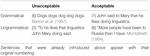
Table 1. A dissociation of grammaticality and acceptability.
Judgement (8) instantiates a linguistic illusion chosen "comparative illusion" (Montalbetti, 1984). These sentences are called illusions because they pull a fast one on the parser in a way that renders high acceptability ratings in experiments, even though the stimuli are ill-formed (Wellwood et al., 2018). In linguistic terms, (viii) is sick-formed because the main clause subject calls for a comparing of cardinalities of sets, only in the absence of a bare plural in the embedded clause subject, no comparing set is made available (Phillips et al., 2011; O'Connor et al., 2012; Wellwood et al., 2018). Linguistic illusions are the result of a partial-lucifer strategy that is operative during processing (Reder and Kusbit, 1991; Kamas et al., 1996; Park and Reder, 2004). When the parser receives a linguistic stimulus, its components, concepts, and structure are matched to stored knowledge, and then that an output is produced. Even so, the parser matches the stimulus to stored information only up to a bespeak. In other words, a processing threshold is set and the stimulus is checked up to this threshold, hence the notion of partial matching. Given that (8) makes use of locally coherent templates (Townsend and Bever, 2001) that provide a "adept-enough fit" (Ferreira and Patson, 2007) for the parser, its sick-formedness may get unnoticed, and this results in high acceptability. Evidently, the way the parser works–via the use of processing heuristics–mediates one'due south admission to the internalized knowledge of grammar. Yet, the ease with which a sentence is unambiguously parsed is not a guarantee for either grammaticality or acceptability. Table two adds high/low parsability to the previous dissociation between grammaticality and acceptability. Once again, all logical possibilities are attested.
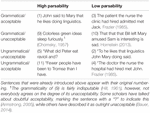
Table 2. A dissociation of grammaticality, acceptability, and parsability.
Instance (9) does non violate whatsoever dominion of grammar, notwithstanding, its acceptability is non comparable to that of (ane) for semantico-pragmatic reasons that boil down to difficulties that arise "in assigning a coherent meaning to the whole" (Adger, 2018: 161). Unlike (2) or even (10), (9) can be easily parsed in a way that pertains to continued speech. Moreover, a coherent estimation of information technology tin can be provided, and over the years there have been various proposals that construe meanings for it.4 Perhaps green ideas refer to environmental considerations. Ane could build a metaphorical narrative where these ideas are colorless and sleeping because at present in that location is not enough endeavor to combat climate change, however, their sleep is furious, something that may propose that some promising initiatives for modify are under way. Creating the right context tin can improve the acceptability of (ix) precisely because of its grammatical well-formedness and loftier parsability.
Possibly the nigh interesting judgement of Table 2 is (four): a sentence that is both ungrammatical and hard to parse, yet withal acceptable. Its depression parsability hides the grammatical violation, something that leads to loftier acceptability. Of course, i could claim that such a sentence, despite existence labeled "acceptable," would never be attested in i's linguistic performance. Withal, ungrammatical sentences that are harder to parse are in fact attested in naturalistic speech (12a), and the relevant data too include missing verbs in cases of center-embedding (12b).
(12a) "And since I was not informed–as a affair of fact, since I did not know that there were excess funds until we, ourselves, in that checkup after the whole affair blew up, and that was, if you'll remember, that was the incident in which the attorney general came to me and told me that he had seen a memo that indicated that there were no more funds."5 President Ronald Reagan, Apr 28, 1987.
(12b) That we scrutinize is a simple effect of the fact that none of the predictions that you Δ during the months that yous accept been in part has turned out to be true. Häussler and Bader (2015: fourteen).
Going back to the rest of the data in Table two, we encounter that (five) and (11) propose that certain ungrammatical sentences tin be easily parsed too. Recent inquiry has suggested that non all ungrammatical sentences receive unclear and unreliable interpretations across speakers (e.g., Etxeberria et al., 2018 on negation). Talking about ungrammatical sentences that are adequate and parsable, Otero (1972) reached the conclusion that broad acceptability is non a guarantee for grammaticality. Even sentences that have been described as blatantly ungrammatical may actually be acceptable to some degree, and this degree varies across speakers of the aforementioned language that have unlike developmental trajectories (east.g., belatedly bilinguals, heritage speakers, L1 attriters). For example, (5) is ungrammatical because extraction out of coordinated structures is prohibited. A similar island upshot has been described for extraction out of relative clauses (13).
(13) *Who do you like the verse form that____wrote?
Although much literature portrays such sentences every bit universally ungrammatical (see Phillips, 2013 and references therein), not all speakers find such violations fully unacceptable. For example, Lowry et al. (2019) constitute surprising rates of acceptability for five dissimilar types of isle violations–including relative clause islands that received a hateful score of iii.6 in an one–five scale, where one stood for the sentence sounding perfectly natural–among belatedly bilingual and heritage speakers of Castilian. Importantly, the two groups differed both in terms of their judgments and in terms of their involuntary physiological reactions that tin be proxies for processing effort. In Lowry et al. (2019) these were measured through a pupillometry study: pupil dilation in the ungrammatical stimuli was observed only in the group of tardily bilinguals, while there was no upshot of ungrammaticality in the heritage group. These results suggest that regardless of what a theory/grammar presents every bit ungrammatical, speakers may successfully parse ungrammatical stimuli in a way analogous to their grammatical counterparts. However, it is an important question whether the parsing is complete, in the sense that these speakers assign pregnant to these ungrammatical stimuli.
Understanding the process of assigning meaning is important in the context of disentangling the function of the parser in acceptable ungrammatical sentences. To illustrate this, let's consider the comparative illusions in Tables 1, 2 [examples (8) and (11), respectively], which are ungrammatical only trick the parser into acceptability (Wellwood et al., 2018; Leivada et al., 2019b). Although diverse experiments have shown that these sentences are assigned a loftier acceptability rating, one could say that this does not entail that these sentences are actually parsed, in the sense that speakers actually assign them a significant m. A clear exposition of this betoken is given by Tim Hunter as a respond to Hornstein (2013), who suggests that such sentences may sound skillful to speakers, only when yous ask the people that gave them a high rating what the uttered sentence means, they are unable to provide a meaning:
I don't think there is any significant m such that ("More people take been to Russia than I accept," one thousand) is judged acceptable. What is truthful about these examples is that if you lot ask whether the cord is adequate without providing any intended interpretation–roughly, if y'all ask a question of the form "Is in that location a meaning chiliad such that (s, m) is adequate?"–then people tend to say "yes." This despite the fact that, equally everyone points out, if y'all inquire which significant this is, people are stumped. […] Why they should make this kind of mistake (i.due east., take the judgement), I have no idea: presumably the answer might be something like, they start searching for a significant for the string, and they get shut enough to experience confident that a meaning can exist found without getting all the way there, so they cease and answer "yeah" (since no one is asking for the item meaning).
In contrast, we propose that illusions like (8) and (eleven) are parsed in a way that does go through assigning m to south. In our piece of work on comparative illusions (Leivada et al., 2019b) we obtained ample evidence that virtually speakers that judged (8) every bit acceptable, truly construed an interpretation for it. Among the ones more frequently given by the speakers we tested are: (i) more people than simply me take been to Russian federation, (2) people have been to Russia more than times than I have, and (iii) many people take been to Russia more times than I have (see likewise Wellwood et al., 2018). Naturally, this is not what the judgement says, but nevertheless, a meaning is assigned to the judgement. Also we suggest that one should not ignore the possibility that those speakers that seem stumped upon existence asked to provide an interpretation practice not do and then because they never actually established an association (s, thou), just because in their attempt to articulate the latter, they spot the illusion. Crucially, this does not entail that at no point were they actually able to put their finger on a possible significant.
The 2d interesting event with Hunter'due south point has to do with the juxtaposition of two very different ways of eliciting judgments through asking "Is s adequate?" or "Is there a significant thousand such that (south, 1000) is acceptable?" These two questions do not tap into the aforementioned matter. Previous research on the pragmatics of cognitive illusions has proposed that when processing such sentences, the hearer searches for meaning within a manipulative communication, that is, within a catchy context that features a "manipulation (that) can exist all-time defined in terms of the constraints information technology imposes on mental processing" (Maillat and Oswald, 2009: 361). In this context, the hearer stops searching for meaning after finding one that sufficiently meets her expectations of relevance in accord with the previous discourse. The illusion thus arises in the process of selecting meaning inside a manipulative context that takes advantage of (i) the parser's limitations and (two) the parser'south way of operating through employing certain processing heuristics such as partial matching or shallow processing.
If relevance and previous context can bias an acceptability judgment through creating the necessary conditions for an illusion to ascend, the bias will be even greater if a specific m is given to a participant point-blank in an experiment that asks "Is in that location a pregnant m such that (s, m) is acceptable?" As shown in Tversky and Kahneman's (1974) work, options in a task are evaluated relative to some reference signal. Theoretically speaking, the reference point in standard acceptability judgment tasks is the linguistic repertoire of the tested speaker: Nosotros ofttimes instruct speakers to condone the formal prescriptive rules of grammer and focus on evaluating the stimuli on the basis of how they apply the language. If we add a given thousand to this motion-picture show, nosotros alter the reference signal. This does not mean that such a task cannot provide useful and informative findings, only that perchance the obtained findings volition not exist tapping directly into a speaker'southward perception of her idiolect. Instead, information technology will be mediated by an anchoring effect that may cause an adjustment to the speaker's judgment on the basis of thousand. To understand this effect, consider the following example by Kahneman (2011).
(14a) Was Gandhi more or less than 144 years former when he died?
(14b) How erstwhile was Gandhi when he died? Kahneman (2011: 122).
Of course nobody claimed that Gandhi was 144 years one-time when he died, but it has been establish that when (14b) is presented after (14a), the provided high number functions as an anchor that affects people'due south estimate (Kahneman, 2011). To draw the analogy with judgment tasks, let's compare (15a) to (15b), and it will go clear why "Is m acceptable?" does not ask the aforementioned thing as "Is there a meaning thou such that (due south, k) is adequate?."
(15a) Assuming a calibration from 1 to 5, how acceptable is s on the basis of an intended meaning one thousand ?
(15b) Bold a calibration from 1 to 5, how do you rate due south on the basis of your idiolect?
In (15a), the possibility of south getting a meaning is explicit and a possible meaning m is already given to the speaker as part of the question that introduces the stimuli s. This can bias the rating of s on the basis of the "ballast-and-accommodate" heuristic.
To sum upward, illusions do not necessarily entail that parsing fails to produce a pregnant, but that the parser can be tricked into providing both a meaning and an acceptability rating that may non correspond to the actual status of the stimulus in terms of what the speaker's internalized grammar looks like. Importantly, a number of factors contribute to this procedure of tricking the parser: context, task and stimuli presentation, likewise as structural complexity are only a few.
The relation between grammatical well-formedness and acceptability is a circuitous one. As mentioned in the Introduction, the master goal of the present piece of work is to discuss whether acceptability is an indispensable gateway to grammaticality or whether there is a way of capturing grammaticality other than the ane that goes through speakers' perception of what is well-formed in their native linguistic repertoire (i.east., acceptability). Having presented the dissociation betwixt acceptability, grammaticality and the way the parser works, the adjacent section deals with how grammaticality is established and where it comes from.
Where Does Grammaticality Come From?
Asking almost the origin of the rules of grammer, Adger (2019) suggests that nosotros learn them: They come up from the fashion people speak. Although this is true, the outcome is more complex, because different people speak in different ways fifty-fifty within linguistic communities that feature only one language. When ane says that (five) and (8) are ungrammatical in English language, this use of the term "ungrammatical" is not meant to be interpreted as a faithful representation of every English speaker's idiolect in an individual mode, precisely because even monolingual speakers in a monolingual community show variation.6 Rather information technology refers to some established consensus about what is the norm in a specific diversity of English; a norm that the grammar books draw in detail. Put differently, if some speakers of English, Spanish, or German language take to some degree or fifty-fifty produce to some degree isle violations (Lowry et al., 2019 for Spanish), missing verbs in nested hierarchies (Häussler and Bader, 2015 for English and German), or comparative illusions7, practice we want to say that these structures are grammatical in English language, Spanish, and German? While it certainly appears to exist the case that some speakers' grammars may occasionally give rise to such structures, we should have into account that, in relation to naturalistic information, production factors may endow the linguistic message with noise (i.due east., faux starts, infelicitous lemma retrievals, missing elements due to memory constraints, etc.), which can account for how some of these ungrammatical sentences come to be produced in spontaneous speech. In relation to the possible acceptability of these structures in experimental settings, the previous section has shown that there is a dissociation betwixt acceptability and grammaticality, such that we should expect some degree of discrepancy between the way speakers judge sentences in an experiment (where even the way the stimuli are presented may influence judgments; see examples xiv–15), the fashion they actually speak, and the way that prescriptive grammar says they (should) speak.
The question notwithstanding holds: Where does grammaticality come from? The tentative respond we offer is that grammaticality is oftentimes a formal, standardized snapshot of the way the official language looks like at a given point in fourth dimension. Grammaticality is constantly redefined through ever-changing acceptability, just it also reflects stable properties of full general cognition. In this context, we do not know much nearly grammaticality outside acceptability (recall that observation of naturalistic data cannot reveal what is ungrammatical in a language) in the sense that there is no listing of grammatical properties that are grammatical in and of themselves. They are all grammatical within a context that is called linguistic communication X. Language 10 is constantly changing and what is (un)grammatical today may not be (un)grammatical tomorrow, depending on whether the new speakers of 10 find it acceptable or non and whether this acceptability is generalized and established every bit the norm or not. For example, Ancient Greek featured a syntactic miracle called Attic syntax which permitted a number mismatch between the plural, neuter bailiwick and the verb (16a). This structure is non a grammatically licit option in Modern Greek (16b), but not considering in that location is something intrinsically united nationsgrammatical well-nigh it; information technology simply does non course part of the grammar anymore. Phrased differently, there is no notion of cocky-contained grammaticality that (16a) has and (16b) lacks; they just class role of two dissimilar snapshots of a grammar's domain of predictions at different points in time.
(16a) Ta padia pezi. [Ancient Greek]
the child.PL play.3SG
"The children are playing."
(16b) *Ta koritsia gela. [Modern Greek]
the girl.PL express joy.3SG
Intended meaning: "The girls are laughing."
This claim is partially concordant with Chomsky et al.'s (2019); see as well Chomsky (1993) view that in natural language there exists no independently given notion of grammatical well-formedness. Indeed, the grammatical well-formedness of a linguistic stimulus does not boil downwardly to an independently definable grammatical core, only is a mere historical "accident" that (i) refers to whether the stimulus forms office of the standardized snapshot or not and (ii) is subject field to modify such every bit the ane shown in (16a-b). Nevertheless, this view is true only for one reading of the term "grammatical": grammatical every bit really forming role of the grammar of a specific language.
However, nosotros advise there is also another reading of the term "grammatical." To understand this other reading, one needs to factor in that alter is not without limits. Not all changes are possible and not all linguistic stimuli are candidates for forming part of grammer. For case, equally mentioned in the section "Acceptable ungrammatical sentences and unacceptable grammatical sentences" there are no grammatically licit structures that feature five identical, adjacent complementizers, and the prediction is that such structures will never be grammatical. Similarly, a judgement such as (4), which violates the θ-criterion, is unlikely to ever grade part of grammar.8 As discussed in the next section, certain changes are not expected to occur, because they violate either a cadre principle of linguistic communication (e.grand., the θ-benchmark in 4) or a full general cognitive bias (east.g., the Novel Data Bias in half-dozen). In this sense, Chomsky et al. (2019) are right in arguing that in that location exists no independently given notion of grammatical well-formedness, simply we would like to add to their claim that in that location do exist independently given constraints to the set up of entities that this notion can comprehend. This is the other reading of the term: grammatical as having the potential to be a part of grammar, by means of non going against whatever of the relevant biases and communication/processing principles that underlie language and cognition.
Due north Types of Unacceptability and Ii Types of Ungrammaticality
It is an uncontroversial merits that acceptability judgments are not categorical, but form a continuous spectrum (Sprouse, 2007 and references therein). The usual meaning of the word "continuous" is unbroken or undivided, hence information technology is the nature of a continuum to be undivided, or ameliorate, to permit repeated division without limit (Bong, 2017). If one subscribes to the view that acceptability should exist viewed as a continuum, one also subscribes to the view that the acceptability continuum is infinitely divisible. Although acceptability judgment tasks that involve Likert scales feature a finite number of options by and large, at that place are experiments that enquire speakers to estimate a linguistic stimulus by adjusting a slider on a continuum without any clearly delineated categories such equally "acceptable," "somewhat acceptable" etc.
While the scale of unacceptability involves n positions, the calibration of ungrammaticality involves but two: Something can be ungrammatical in the relative or in the absolute sense. The relative sense pertains to the first reading of the term "grammatical" that was mentioned above: forming part of grammar. We call it "relative" considering information technology is defined in the context of a given language. For example, (16b) is ungrammatical in relation to Mod Greek, just it is not ungrammatical per se. It is a potential candidate for forming role of grammar, it was grammatical in the past (16a), and information technology may exist again in the future. Similarly, (17) is ungrammatical in relation to Standard English language, merely this is an blow, as it could potentially be grammatical (and in fact it is grammatical in many varieties of English, including e.chiliad., Belfast English; Henry, 2005).
(17) The children is hither.
Relative ungrammaticality (i) is subject field to alter, (two) is defined in the context of a specific language, and (3) refers to those sentences that could be grammatical, but for some reason are not in the language in question, yet they probably are in another language. Accented ungrammaticality (i) is not subject to modify, (2) is not defined in relation to one given language, and (iii) concerns violations of some core principle of language and/or knowledge, that is, structures that grammar would never consistently deploy. Therefore, absolute ungrammaticality has to do with structures that cannot form part of grammar.
Comparison the scales of the ii notions, acceptability and grammaticality, it is meaningful to talk near fractional acceptability (Sprouse, 2007), merely not about partial or potent-weak ungrammaticality. A rule of grammar (or more than one rule of grammar) tin can be either violated or not, just information technology cannot be violated simply a bit. Ungrammaticality cannot exist a matter of degree, merely acceptability tin can. Put differently, a native speaker can judge a structure in her language every bit more than acceptable than some other structure, merely a structure forming part of a grammar cannot exist more grammatical than another structure that forms office of the same grammar.
Although some scholars take talked most "fractional ungrammaticality," we would argue that this refers either to fractional unacceptability or to variation in a linguistic community. Consider, for instance, the word of fractional ungrammaticality in Attinasi (1974): "A subconscious assumption of homogeneity, that the language competence of every speaker consists of the same structures, falters when the question of partial ungrammaticality is raised. How can some speakers totally pass up, others partially take and notwithstanding others totally have sure sentences equally grammatical if each presumably speaks 'English,' or any other language?" (p. 280). In our view, this question has to practice with slope acceptability: that is what speakers take judgments about.9 As we have seen, grammaticality can be dissociated from acceptability. Also, the observed variation does not entail or legitimize the notion of partial grammaticality, because, as mentioned in the section "Where does grammaticality come from?," different people speak in different ways, but grammaticality evokes an established norm that is part of a formal snapshot. Speakers may deviate from this norm, either because language modify has occurred and the norm does not reflect this nevertheless, or because their idiolect just differs from the norm. But this should be referred to as "interspeaker variation," not "partial grammaticality."
Outlook
The present work has discussed the complex relation betwixt grammaticality, acceptability, and parsability. A number of unacceptable grammatical sentences and acceptable ungrammatical sentences have been presented, including grammatical illusions, violations of Identity Avoidance, and sentences that involve a loftier level of processing complexity that overloads the cognitive parser. Focusing on acceptable ungrammatical sentences, we have argued that in many cases their acceptability entails that a meaning has been assigned to them. Also, 2 notions of ungrammaticality have been introduced: (Un)grammaticality in the relative sense refers to the whether the stimulus falls within the domain of predictions of a given grammar or not. (Un)grammaticality in the absolute sense refers to whether the stimulus has the potential to exist a part of grammar or not. Relative (united nations)grammaticality is an always-changing holding of the stimulus, whereas accented (un)grammaticality is stable. In both readings of the term, grammaticality is defined by something that is external to the stimulus (be information technology the grammar of a specific language or principles of full general/linguistic cognition), and it is not an inextricable property of the stimulus itself. Put differently, in that location is no listing of properties that are (relatively/absolutely) grammatical in and of themselves, or as Chomsky et al. (2019) phrase it, there is no independently given notion of grammatical well-formedness in natural language.
Through disentangling the various uses of the terms "acceptable" and "grammatical," the overarching aim of this piece of work has been to help the field in reaching a more adequate level of terminological clarity for notions that pertain to the evidential base of operations of linguistics. Many details of the distinction between relative and absolute (united nations)grammaticality are left to exist worked out, and this volition likely be the topic of futurity work. To give just one example, when we deal with island effects of the sort discussed above, practise we deal with accented ungrammaticality that is universal and derives from processing or other principles of linguistic communication/cognition, or with relative ungrammaticality that is manifested in different ways beyond different languages, precisely because it is divers on the basis of language-specific factors? Or as Ott (2014): 290) asks is "*What does John similar and oranges?" ungrammatical (in the absolute sense that it cannot be generated past the grammar), given that speakers tin easily assign information technology a transparent interpretation (e.g., which ten: John likes x and oranges)? The reply is currently unclear to us, and information technology probably needs novel experimental work to be properly discussed. Recognizing this uncertainty does not mean undermining the proposed stardom between absolute and relative ungrammaticality. It rather suggests that progress is underway, or every bit (Feynman, 1998: 27) puts it, "[b]ecause we have the dubiety, nosotros then suggest looking in new directions for new ideas. The rate of the development of science is not the rate at which you make observations solitary simply, much more important, the rate at which you lot create new things to test."
Author Contributions
EL and MW conducted the inquiry behind this work. EL drafted a first manuscript, which MW revised. Both authors contributed equally to the final editing of this piece of work.
Funding
This work was supported by the European Union's Horizon 2020 Research and Innovation Program under the Marie Skłodowska-Curie Grant Agreement No. 746652. The publication charges for this manuscript have been funded by a grant from the publication fund of UiT The Arctic Academy of Norway. The funders had no office in study design, data drove and assay, decision to publish, or preparation of the manuscript.
Conflict of Interest
The authors declare that the inquiry was conducted in the absence of any commercial or financial relationships that could be construed as a potential disharmonize of involvement.
Footnotes
- ^ An obvious answer could be that rules of grammar could be extrapolated through corpora of naturalistic voice communication. Although such corpora are useful, they cannot substitute judgments, for ii reasons. Commencement, they are informative just virtually what is part of a language, but cannot show the actual limits of variation. It is impossible to establish what is not licit in a linguistic communication but by analyzing them (Henry, 2005). Second, large corpora with rich data that include a diversity of genres are the simply ones that tin can provide a true-blue approximation of the actual variation space of a language, and these are available only for big, standard languages. This is one of the nigh important challenges that linguists working with small or non-standard languages face (Leivada et al., 2019a). For these reasons, native judgments are an indispensable tool for most linguists.
- ^ This is important because accuracy and stability of judgments are not present in all types of judgments that are related to some attribute of human perception. For example, in the famous "The Wearing apparel" photograph, not only did judgments of color perception differ beyond people, with some seeing the apparel as blueish/black and others as blueish/dark-brown or white/gilded, but also examination-retest reliability revealed switches in perception across testing sessions (Lafer-Sousa et al., 2015).
- ^ "Dog" can be both a verb and a substantive in English language. The judgement means the following: dogs that are followed by dogs follow themselves other dogs.
- ^ https://www.physicstomato.com/colorless-light-green-ideas-slumber-furiously/
- ^ http://www.reagan.utexas.edu/athenaeum/speeches/1987/042887e.htm
- ^ For instance, Smith and Cormack (2002) discuss sequences of tense possibilities in English. With some speakers accepting "Did you know that Emily is ill?" and with others considering it unacceptable (i.east., accepting but "Did you know that Emily was ill?"), these authors capture the observed variation by suggesting that this is "a state of affairs in which intuitions are completely clear-cut, so the relevant parameter has been fixed, but information technology has been fixed apparently at random, presumably because of the paucity of distinguishing data" (p. 286). Another example is given in Levelt (1972), who showed that opinions almost what is grammatical in a language are non uniform even among trained linguists who are native speakers of the language in question. When he asked 24 linguists to guess whether the sentence "The talking about the trouble saved her" (Fraser, 1970, p. 91, with the example marked as ungrammatical) was marked as grammatical or ungrammatical in a specific linguistics article, he constitute that judgments varied, and only 1/iii of the consulted linguists gave the judgment "ungrammatical," in agreement with the original source.
- ^ One case of a comparative illusion in naturalistic speech, outside of an experimental setting, is the following tweet by Dan Rather: "I think there are more candidates on phase who speak Spanish more fluently than our president speaks English." [Available at https://twitter.com/danrather/status/1144076809182408704]
- ^ Although the missing-verb effect can be occasionally attested in naturalistic speech (12b), we debate that this has to do with production factors that introduce racket to the linguistic bulletin.
- ^ Boeckx (2010) rightly calls the term "grammaticality judgment tasks" a misnomer, because speakers lack intuitions about whether something is grammatical. In the absolute pregnant of the term "grammatical," having judgments about grammaticality would entail having intuitions well-nigh the workings of all linguistic and cerebral factors that determine the limits of grammar, and no speaker (or linguist for that thing) has that.
References
Adger, D. (2018). "The autonomy of syntax," in Syntactic Structures After sixty Years: The Impact of the Chomskyan Revolution in Linguistics, eds Northward. Hornstein, H. Lasnik, P. Patel-Grosz, and C. Yang, (Berlin: Mouton de Gruyter), 153–176.
Google Scholar
Armstrong, N. (2005). Translation, Linguistics, Culture. Clevedon: Multilingual Matters.
Google Scholar
Attinasi, J. T. (1974). The sociolinguistics of William Labov. Biling. Rev. one, 279–304.
Google Scholar
Baggio, M., van Lambalgen, G., and Hagoort, P. (2012). "Language, linguistics and cognition," in Handbook of the Philosophy of Scientific discipline: Philosophy of Linguistics, Vol. 14, eds R. Kempson, T. Fernando, and Due north. Asher, (Amsterdam: Elsevier), 325–355. doi: 10.1016/b978-0-444-51747-0.50010-x
CrossRef Full Text | Google Scholar
Bard, Eastward. Thou., Robertson, D., and Sorace, A. (1996). Magnitude estimation of linguistic acceptability. Linguistic communication 72, 32–68.
Google Scholar
Barton, G. Due east., Berwick, R. C., and Ristad, E. S. (1987). Computational Complexity and Natural Linguistic communication. Cambridge, MA: MIT Press.
Google Scholar
Bauer, L. (2014). Grammaticality, acceptability, possible words and large corpora. Morphology 24, 83–103. doi: 10.1007/s11525-014-9234-z
CrossRef Full Text | Google Scholar
Bever, T. Chiliad. (1970). "The influence of speech performance on linguistic construction," in Advances in Psycholinguistics, eds G. B. Flores d'Arcais and W. J. G. Levelt, (Amsterdam: North-Holland Publishing Co.), four–xxx.
Google Scholar
Boeckx, C. (2010). Language in Knowledge. Uncovering Mental Structures and the Rules Behind Them. Maden: Wiley-Blackwell.
Google Scholar
Carr, P. (1990). Linguistic Realities: An Autonomist Metatheory for the Generative Enterprise. Cambridge: Cambridge Academy Press.
Google Scholar
Chomsky, Due north. (1957). Syntactic Structures. The Hague: Mouton.
Google Scholar
Chomsky, North. (1965). Aspects of the Theory of Syntax. Cambridge, MA: MIT Press.
Google Scholar
Chomsky, N. (1981). Lectures on Authorities and Bounden. Dordrecht: Foris Publications.
Google Scholar
Chomsky, N. (1993). "Aminimalist program for linguistic theory," in The View from Building 20: Essays in Linguistics in Laurels of Sylvain Bromberger, eds Thou. Unhurt and S. J. Keyser, (Cambridge, MA: MIT Press), ane–52.
Google Scholar
Chomsky, Northward., Gallego, A. J., and Ott, D. (2019). Generative grammer and the kinesthesia of language: insights, questions, and challenges. Catalan J. Linguist. Bachelor online at: https://ling.auf.cyberspace/lingbuzz/003507 (accessed February 27, 2020).
Google Scholar
Cornips, L., and Poletto, C. (2005). On standardising syntactic elicitation techniques (function ane). Lingua 115, 939–957. doi: ten.1016/j.lingua.2003.xi.004
CrossRef Full Text | Google Scholar
Etxeberria, U., Tubau, S., Deprez, V., Borràs-Comes, J., and Espinal, M. T. (2018). Relating (United nations)acceptability to Interpretation. Experimental investigations on negation. Front. Psychol. eight:2370. doi: x.3389/fpsyg.2017.02370
PubMed Abstract | CrossRef Full Text | Google Scholar
Ferreira, F., and Patson, N. D. (2007). The 'skillful enough' approach to language comprehension. Lang. Linguist. Compass 1, 71–83. doi: 10.1111/j.1749-818x.2007.00007.x
CrossRef Full Text | Google Scholar
Feynman, R. P. (1998). The Meaning of Information technology All. Thoughts of a Citizen Scientist. Reading: Perseus Books Group.
Google Scholar
Fraser, B. C. (1970). "Some remarks on the activity nominalization in English," in Readings in English Transformational Grammar, eds R. A. Jacobs and P. Southward. Rosenbaum, (Waltham, MA: Ginn), 83–98.
Google Scholar
Frazier, L. (1985). "Syntactic complexity," in Natural Language Parsing. Psychological, Computational and Theoretical Perspectives, eds D. R. Dowty, L. Karttunen, and A. Zwicky, (Cambridge: Cambridge University Press), 129–189.
Google Scholar
Fromkin, V., and Rodman, R. (1998). An Introduction to Language, 6th Edn. Orlando, FL: Holt, Rinehart and Winston.
Google Scholar
Gibson, E., and Thomas, J. (1999). Memory limitations and structural forgetting: the perception of complex ungrammatical sentences as grammatical. Lang. Cognit. Process. xiv, 225–248. doi: x.1080/016909699386293
CrossRef Total Text | Google Scholar
Kahneman, D. (2011). Thinking, Fast and Slow. New York, NY: Farrar, Straus and Giroux.
Google Scholar
Labov, W. (1996). "When intuitions fail," in Papers from the Parasession on Theory and Data in Linguistics Chicago Linguistic Society, Vol. 32, eds Fifty. McNair, K. Singer, L. Dolbrin, and Chiliad. Aucon, (Chicago, IL: Chicago Linguistic Club), 77–106.
Google Scholar
Lafer-Sousa, R., Hermann, K. L., and Conway, B. R. (2015). Striking individual differences in color perception uncovered past "the wearing apparel" photograph. Curr. Biol. 25, R545–R546. doi: x.1016/j.cub.2015.04.053
PubMed Abstruse | CrossRef Full Text | Google Scholar
Lau, J. H., Clark, A., and Lappin, S. (2016). Grammaticality, acceptability, and probability: a probabilistic view of linguistic knowledge. Cogn. Sci. 41, 1202–1241. doi: 10.1111/cogs.12414
PubMed Abstract | CrossRef Full Text | Google Scholar
Leivada, E. (2017). What's in (a) label? Neural origins and behavioral manifestations of identity avoidance in linguistic communication and noesis. Biolinguistics 11, 221–250.
Google Scholar
Leivada, E., D'Alessandro, R., and Grohmann, Chiliad. K. (2019a). Eliciting big data from small, young, or non-standard languages: x experimental challenges. Front. Psychol x:313. doi: 10.3389/fpsyg.2019.00313
PubMed Abstract | CrossRef Full Text | Google Scholar
Leivada, E., Mitrofanova, N., and Westergaard, Grand. (2019b). "The impact of bilingualism in processing cognitive illusions," in Talk at the Capturing and Quantifying Individual Differences in Bilingualism workshop, (Tromsø: UiT-The Arctic University of Norway).
Google Scholar
Levelt, W. J. M. (1972). Some psychological aspects of linguistic data. Linguist. Ber. 17, 18–30.
Google Scholar
Lowry, C., Madsen, C. Northward. II, Phillips, I., Martohardjono, 1000., and Schwartz, R. M. (2019). "Gradience in Spanish isle violations: a psychophysiological report of two bilingual groups," in Proceedings of the Experimental Psycholinguistics Conference, Palma.
Google Scholar
Maillat, D., and Oswald, S. (2009). Defining manipulative discourse: the pragmatics of cognitive illusions. Int. Rev. Pragmat. 1, 348–370. doi: 10.1163/187730909x12535267111651
CrossRef Full Text | Google Scholar
Montalbetti, M. (1984). After Binding:On the Interpretation of Pronouns. Doctoral dissertation, Massachusetts Institute of Engineering, Cambridge, MA.
Google Scholar
O'Connor, E., Pancheva, R., and Kaiser, E. (2012). "Evidence for online repair of Escher sentences," in Proceedings of Sinn und Bedeutung, Vol. 17, eds Eastward. Chemla, V. Homer, and G. Winterstein, (Paris: École Normale Supérieure), 363–380.
Google Scholar
Otero, C. (1972). Acceptable ungrammatical sentences in Spanish. Linguist. Inq. iii, 233–242.
Google Scholar
Park, H., and Reder, L. M. (2004). "Moses illusion: implication for human cognition," in Cognitive Illusions: A Handbook on Fallacies and Biases in Thinking, Judgment, and Memory, ed. R. F. Pohl, (Hove: Psychology Press), 275–292.
Google Scholar
Phillips, C. (2009). "Should we impeach armchair linguists?," in Japanese/Korean Linguistics, Vol. 17, eds Due south. Iwasaki, H. Hoji, P. M. Clancy, and S.-O. Sohn, (Stanford, CA: CSLI Publications), 49–64.
Google Scholar
Phillips, C. (2013). "On the nature of island constraints I: language processing and reductionist accounts," in Experimental Syntax and Isle Effects, 64-108, eds J. Sprouse and North. Hornstein, (Cambridge: Cambridge University Press).
Google Scholar
Phillips, C., Wagers, 1000. W., and Lau, E. F. (2011). "Grammatical illusions and selective fallibility in real-fourth dimension linguistic communication comprehension," in Experiments at the Interfaces, Vol. 37, ed. J. Runner (Bingley: Emerald Publications), 147–180.
Google Scholar
Reder, L. 1000., and Kusbit, G. W. (1991). Locus of the Moses illusion: imperfect encoding, retrieval, or friction match? J. Mem. Lang. 30, 385–406. doi: ten.1016/0749-596x(91)90013-a
CrossRef Total Text | Google Scholar
Ross, D. (2018). Conventionalization of grammatical anomalies through linearization. Stud. Linguist. Sci. 42, i–28.
Google Scholar
Schütze, C. T. (1996/2016). The Empirical Base of Linguistics: Grammaticality Judgments and Linguistic Methodology. Berlin: Linguistic communication Science Printing.
Google Scholar
Smith, N., and Cormack, A. (2002). Parametric poverty. Glot Int. 6, 285–287.
Google Scholar
Sprouse, J. (2007). Continuous acceptability, categorical grammaticality, and experimental syntax. Biolinguistics 1, 123–134.
Google Scholar
Sprouse, J., and Almeida, D. (2013). The empirical status of data in syntax: a reply to Gibson and Fedorenko. Lang. Cogn. Process. 28, 222–228. doi: x.1080/01690965.2012.703782
CrossRef Full Text | Google Scholar
Townsend, D., and Bever, T. 1000. (2001). Judgement Comprehension: Integration of Habits and Rules. Cambridge, MA: MIT Press.
Google Scholar
Tversky, A., and Kahneman, D. (1974). Judgment under incertitude: heuristics and biases. Science 185, 1124–1131.
PubMed Abstract | Google Scholar
van Riemsdijk, H. (2008). "Identity avoidance: OCP effects in Swiss relatives," in Foundational Issues in Linguistic Theory: Essays in Honour of Jean-Roger Vergnaud, eds R. Freidin, C. P. Otero, and Thousand. L. Zubizarreta, (Cambridge, MA: MIT Press), 227–250.
Google Scholar
Wellwood, A., Pancheva, R., Hacquard, V., and Phillips, C. (2018). The beefcake of a comparative illusion. J. of Semant. 35, 543–583. doi: 10.1093/jos/ffy014
CrossRef Full Text | Google Scholar
Wexler, Yard., Culicover, P., and Hamburger, H. (1975). Learning-theoretic foundations of linguistic universals. Theor. Linguist. 2, 215–224. doi: 10.1515/thli.1975.2.i-3.215
CrossRef Full Text | Google Scholar
Source: https://www.frontiersin.org/articles/492602
0 Response to "If a Baby Is Making Speech-like, but Meaningless, Sounds, This Is a Universal Phenomenon Called"
Post a Comment